John Saunders reports: Round one of the 2017 Chess.com Isle of Man Masters took place on Saturday 23 September 2017 at the Villa Marina in Douglas. And the star of the show was not one of the players so much as the implementation of the controversial random pairings experiment. You’ve heard of Brexit? Well, since I’m British and the tournament is held in Britain I’m calling the random pairing system Brandom…
Is Brandom a good thing? It’s a matter of opinion and, arguably, we should wait until the end of the tournament before making a judgement. However, I personally think it was in that it threw up one particularly plum encounter, between the second and third seeds, Vladimir Kramnik and Fabiano Caruana, which also had a bearing on the qualification for the forthcoming World Championship Candidates’ competition. There were numerous other benefits. It also gave a sub-2200 rated player from Iceland the chance to play a once-in-a-lifetime game against a reigning world champion.
Of course, I would say that, wouldn’t I, since in yesterday’s report of the pairings ceremony, I owned up to being the person who suggested Brandom in the first place. (Incidentally, other people connected with the tournament have since come forward to say that they too had suggested something similar to the organisers, so I might be wrong in claiming all the credit/blame for the idea.)
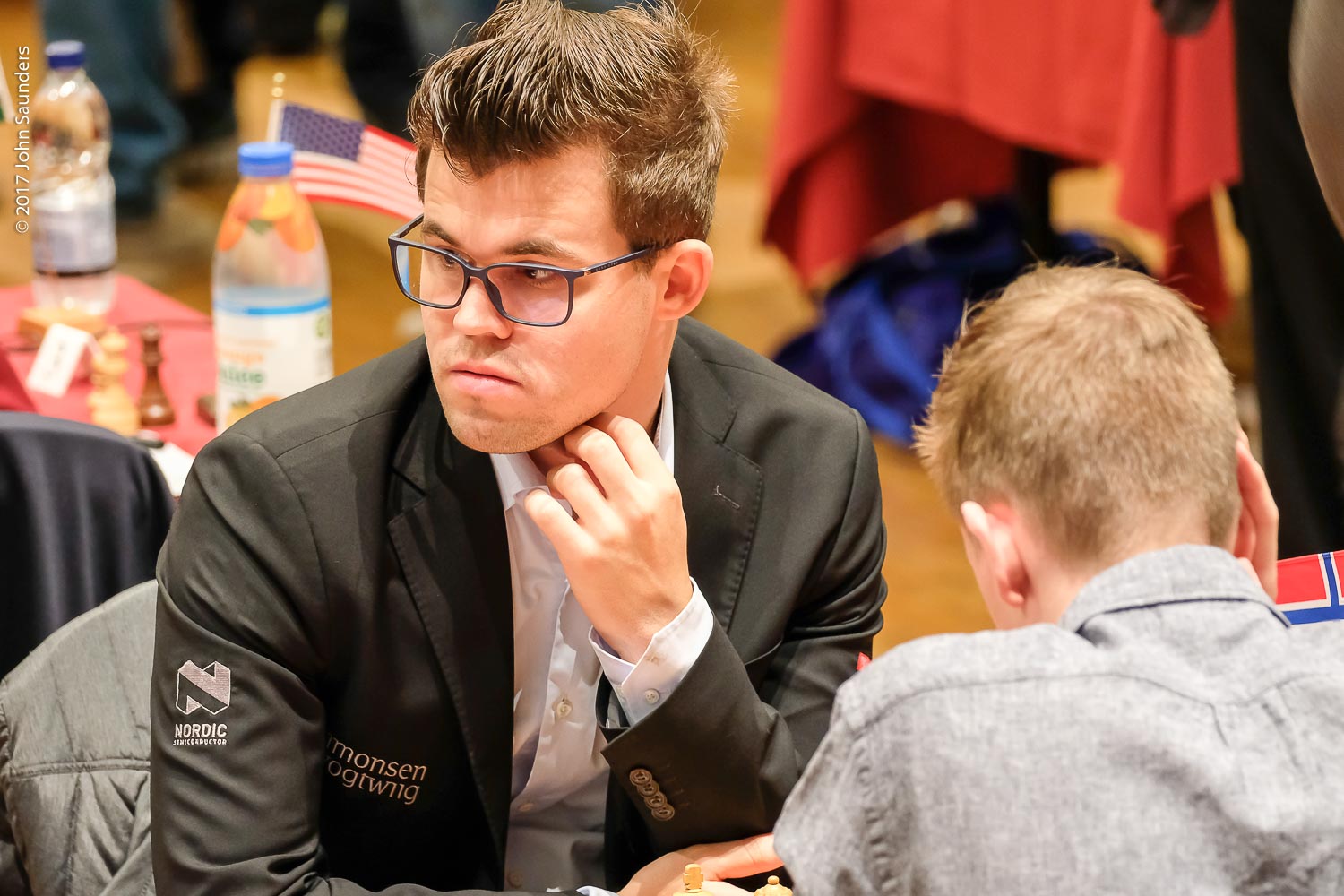
Round 1 was a walk in the park for Magnus. Meanwhile his opponent must have walking on air.
The Three Brandomeers
It all comes down to your philosophy of how these things should be done. On the one side are the conservatives who cleave to the more traditional form of swiss tournament as it has evolved over the past half century think Brandom is a mistake because it introduces an element of unfairness into players’ trajectories through a tournament. Peter Svidler, commenting on chess24, is amongst their number – as he put it, ” it skews everything ” – and I’m sure there will be many others as influential as Peter saying much the same. I’m guessing, after his defeat in round one, Vladimir Kramnik will now be firmly anti-Brandom. On the other side of the fence are the revolutionaries who think that the traditional swiss rules are inherently unfair because they serve to build in an advantage for top players at the expense of the lower rated and think that they should take their chances with everyone else in a random draw and accept the consequences. Quite a number of influential names in the chess world are committed Brandomeers. Three of them, tournament commmentator Simon Williams, Jon Ludvig Hammer and Greg Shahade (the latter two have blogged about and I’ve put in hyperlinks to their comments) seem to take the view that the random experiment as implemented here didn’t go far enough and should have been applied to all rounds of the tournament. From their point of view, what has been implemented in the Isle of Man is a half-measure. They are holding out for full Brandom. I have some sympathy with them.
Incidentally, Brandom is not so revolutionary after all: I’m reliably informed that the English Chess Federation (or its predecessor the British Chess Federation) still has an existing body of rules for Swiss pairings of this sort, which concentrate simply on alternation of colour, pairing with same or similar score and upfloat/downfloat equalisation, but no reference to rating. They still apply in certain events, for instance junior competitions where players have no published rating. It just shows that there is nothing so new as that which has long been long forgotten.
Magnus Carlsen was a beneficiary of the Brandom experiment after receiving a nice, juicy sub-2200 sparring partner to warm up against. It was a win-win – Magnus won the game easily and could take it easy for the rest of the day, while 17-year-old Bardur Orn Birkisson won the right to tell his future grandchildren about the day he faced the legendary Magnus Carlsen in single combat. He didn’t play a bad game.
Enough said about Magnus’s game, except for asking the question as to whether a world champion had ever faced a rank amateur in such a game before. Of course, I wouldn’t have posed the question if I didn’t already know the answer, would I? The precedent was the game Spassky-Banks, from the Canadian Open in 1971. Spassky was the first reigning world champion to put his reputation on the line and play in an open tournament. His opponent in the game was an old club colleague of mine, Derek Banks, who hales from London but was living in Canada at the time. (I think Derek is still around somewhere in the USA and, if he happens to be reading this, I’d like to wish him well.)
Derek Banks played a pretty good game against Boris Spassky, which you can find on various databases (sometimes wrongly ascribed to long-dead US player Newell Banks). Of course Banks lost the game but I recall that the pairing between the world champion and a rank amateur was criticised in a magazine article by Stewart Reuben at the time. I think Stewart wrote something slightly pompous like “It would never have happened in one of my tournaments.” (I can’t check the exact wording as I am away from base at the moment. So I suppose Stewart was amongst the first of the anti-Brandom brigade. I expect he’d be turning in his grave at the implementation of Brandom in the Isle of Man this year, if he were dead. Which he isn’t, by the way. Long may Stewart reign over us. Apologies for the joke at your expense, Stewart, but it is all part of my own campaign to poke fun at all British arbiters in turn. Peter Purland appears to have forgiven me for my egregious sin against him and hopefully you will too.
Turning reluctantly to the chess…
OK, I appear to have churned out nearly 1,000 words so far and barely mentioned the details of round one. I am turning into Harry Golombek. For those readers aged under 80 (and thus possibly outside the demographic of my usual readership) who may not be familiar with his name, Harry used to be the best known British chess journalist of his era (roughly 1940s to 1980s) and eventually developed a distaste for the sports reporting aspect of chess writing, such as “X played a Najdorf against Y and won in Z moves”. This distaste became so obvious to readers that Harry didn’t even try to hide it, famously following a long but fascinating account of whatever it was that interested him at the time with a new paragraph beginning ” Turning reluctantly to the chess…” I fear I too have reached that stage. But this is partly because FM Mike Klein has written such a great on-the-spot account of round one anyway (and, I hasten to add, not in the cliched way I was referring to above). He is higher rated, younger, more talented, funnier and better looking than me (dammit) so how can I possibly compete? OK, maybe I can summmarise the main features and then find a few items to supplement his very comprehensive account.
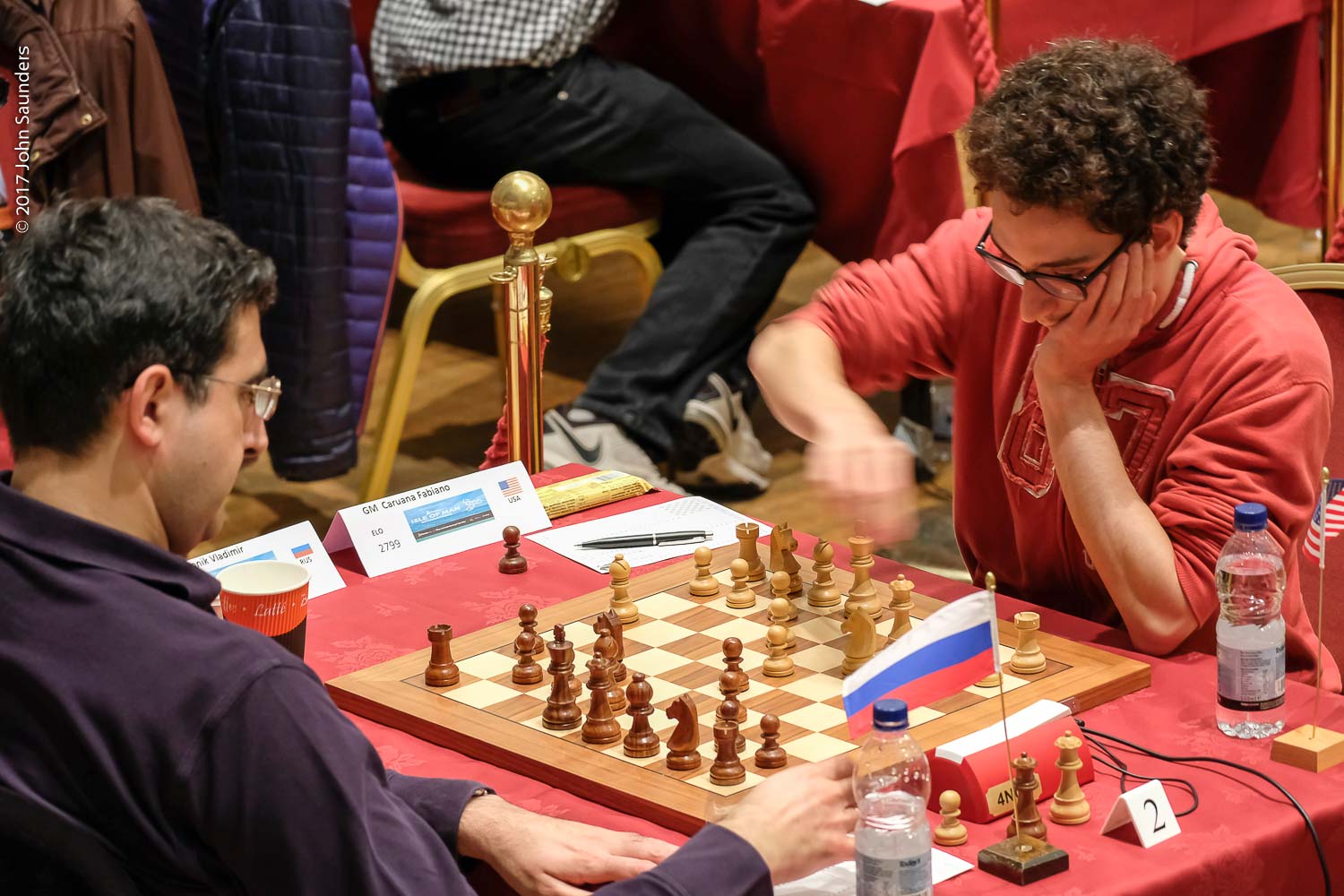
Caruana-Kramnik was the game of the round and both players deserve to share the credit. Vlad probably now wishes they had shared the point.
Caruana-Kramnik was the star attraction. You can play through the moves, with annotations, via the link to Mike’s report above. The important thing was that it was a great fight which did credit to both players and entertained the watching online audience. Super-GM Teimour Radjabov, on Twitter, summed it up brilliantly: ” Long time since I watched Open tournament’s first round! I nteresting pairings and fight since the beginning!“** There was a slight fear that Caruana and Kramnik might go down the line of least resistance, playing out an anaemic draw which complied with the tournament’s easily circumvented 30-move no-draw rule and treat the round as a half-point rest day. So hats off to both of them for not doing that, particularly as the game had repercussions for their Candidates’ qualification chances. Some of those arguing against random pairings online seemed to be saying that his loss ruled out any chance that Vladimir Kramnik might win the tournament but that, frankly, is nonsense. Plenty of players have recovered from bad starts in Swiss tournament and gone on to pick up the trophy. The winning and losing of Swiss tournaments is usually decided over the last three rounds.
Vishy Anand was provided with the opportunity to improve on his 2016 Gibraltar showing when he was paired with Marc Esserman of the USA. Esserman played a Sicilian and defended well for a while but Vishy gradually smoothed his way to victory.
It was business as usual for Hikaru Nakamura who didn’t get where he is today without knowing how to grind out a win in round one. It didn’t look like the logical result for much of the course of the game, and the spectators had difficulty figuring how the win was going to happen (like in all those classic Carlsen grinds) but came it did, eventually, when Hikaru timed a d5-d4 pawn push as his opponent’s time was ebbing away.
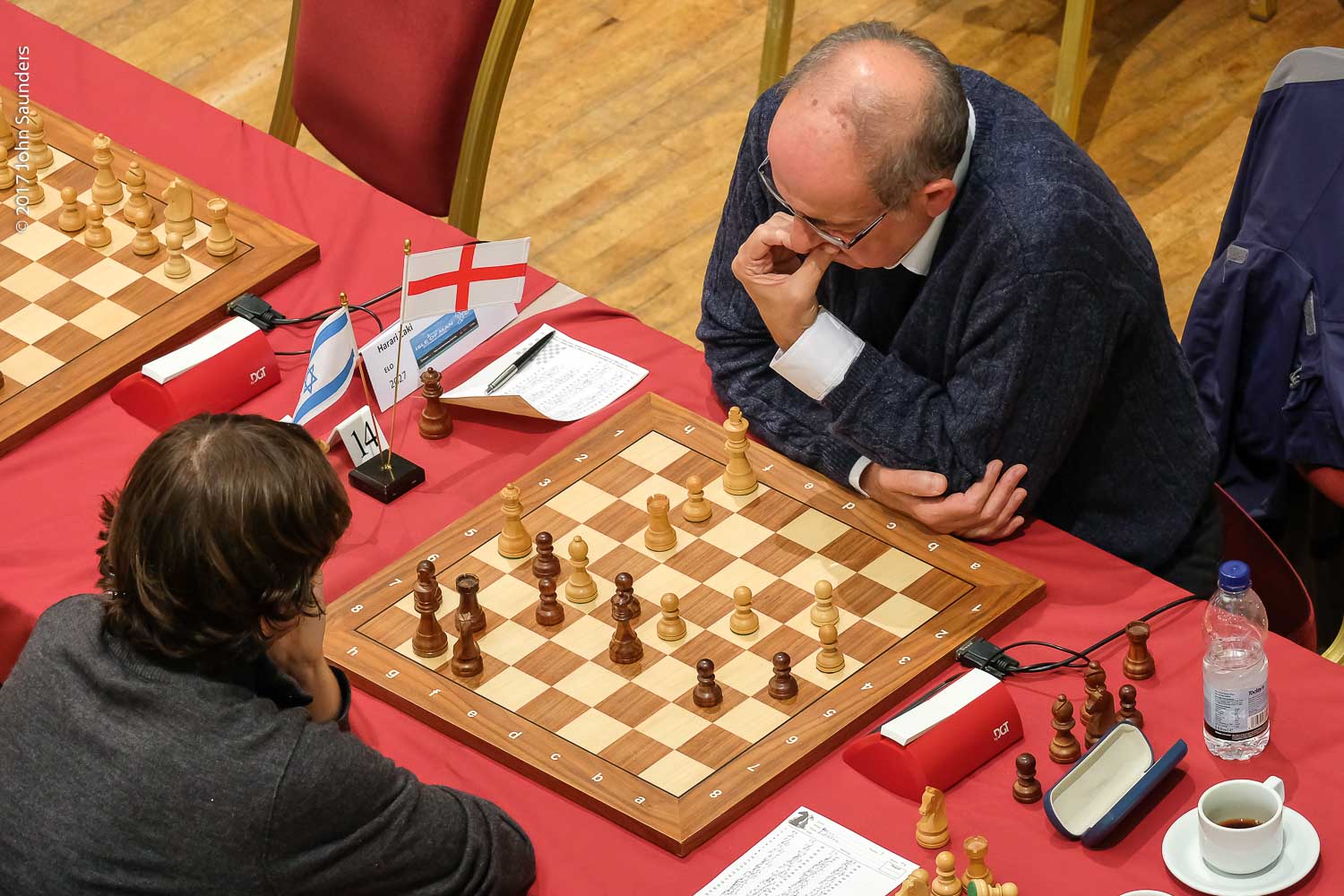
Zaki Harari (White) near the end of his game with Maxim Rodshtein. A draw was extremely good but a win would have been staggering.
Zaki Harari was the improbable hero of the day from a British/American point of view (he’s an American who is chess-registered as English). He is rated 2027 and aged 69 (his 70th birthday is only a few days away) and he managed to draw against Maxim Rodhstein (2695) of Israel, who is also 42 years younger than him. I say “managed to draw” – it could so easily have been a win as he outplayed Maxim with a very bit of tactical play and was on the brink of victory when he baled out for the draw. The win was there, waiting to be found, and not too hard to find either.
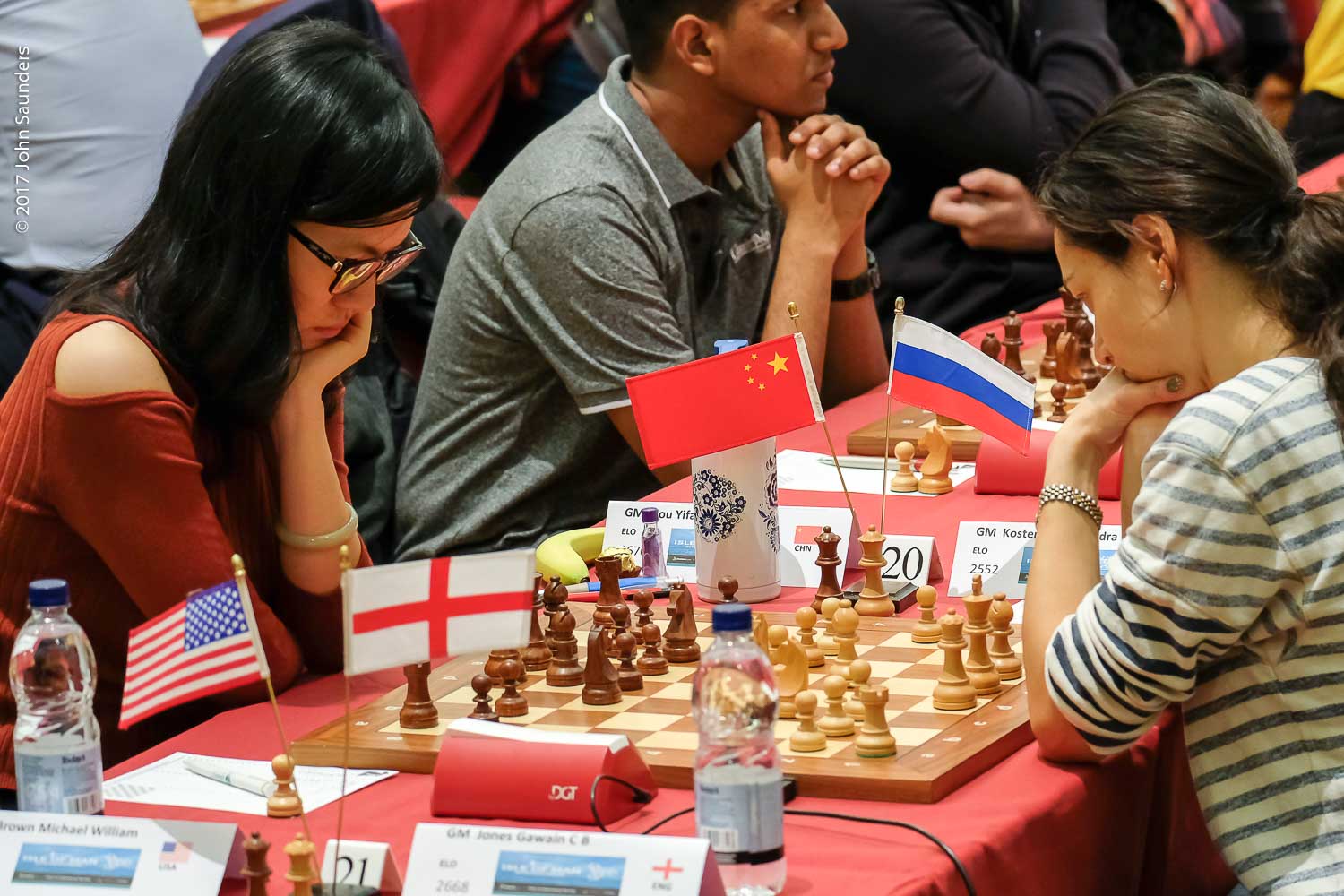
Hou Yifan was randomly paired with a female opponent, Alexandra Kosteniuk. And she was paired with another female opponent in round two!
But thankfully there was no protest about the pairings this time as there was in Gibraltar some months ago.
Back to Brandom for a moment. Hopefully the divide between the anti-Brandom and pro-Brandom camps will not become as toxic as pro versus anti-Brexit has become in Britain. For my part I had dinner last night with someone who is firmly anti-Brandom (while I am pro) and it was an extremely civilised evening featuring a full and frank exchange of views on the subject but absolutely no personal unpleasantness. We did not come to blows and remain good friends. Gens una sumus, brandom atque non brandom, as the Romans used to say.
More from me anon… John Saunders