
Given that the views expressed in my comments here have been biased in favour of ‘Brandom’ (my Brexit-style nickname for the British/Isle of Man random pairing experiment), I thought it would only be fair to post a short summary of the arguments against. The best summary I have seen so far of the anti-Brandom argument has appeared in posts made by English IM Richard Bates on the English Chess Forum.
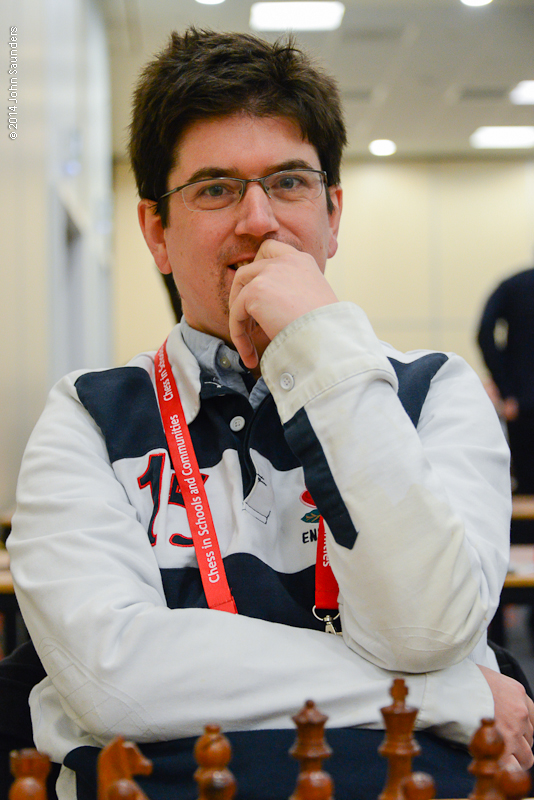
IM Richard Bates, currently rated 2387, and a regular competitor in competitions in the UK
As far as I know, Richard only expresses his views publicly via his occasional posts on the forum and has no other platform to reach a wider audience. This is a pity as he writes extremely well, and has a calm, rational style which make his arguments all the more persuasive. I always enjoy reading Richard’s comments. I’ve no idea whether he himself has any aspirations in this direction but I am hoping someone well-placed in the online chess world will read this and offer him a column so that I can read more of what he has to say.
Anyway, here are a couple of Richard’s posts about ‘Brandom’ which neatly summarise the issues and suggest what he considers to be a more constructive way forward.
“If you have no objective of trying to ensure the best performing players end up at the top of the tournament then there is obviously no problem with random pairings. Everybody has an equal chance of benefitting or suffering from “luck of the draw”. But personally I don’t see why this is desirable – and for professional players and with lots of money at stake I think one should obviously aspire to the initial objective. The argument that a player can sometimes benefit from a favourable draw within Swiss systems is an argument for seeking improvements to Swiss systems, not for making it worse and introducing random pairings and significantly increasing the chances of variance from an “average” set of pairings, and the potential size of that variance.
“The FA Cup [England’s oldest and most prestigious soccer knock-out competition has random pairings for the final six rounds – JS] is in my opinion not a great example because it is the exception rather than the rule in how sporting competitions are organised, which almost all retain some element of seeding to the benefit of the best teams/players and/or to seek that the concluding rounds are contested between the best. And even the FA Cup favours the better teams by entering them later in the competition.
“As for the specific case of just randomising the first round to make the first round more interesting – well, if this is an objective then frankly I think this is far better achieved through well-designed accelerated pairing systems.
“The other point I’d make about standard Swiss systems is that (assuming there aren’t some particularly irregular features in the rating distribution, and excluding “Swiss gambit” gaming of the system [Swiss Gambit – the name given to the tournament strategy of drawing in early rounds of a competition in order to secure easier opposition going forward – JS]) if they favour anybody it tends to favour the stronger players. Taking two players in isolation the stronger player is more likely to be paired against a player weaker than themselves. Although this is compensated by the fact that when the two players are on the same score group in the same half of the draw the stronger player will usually have the tougher pairing.
“And this is fine. If you want to have the best of the draw you just have to get stronger. Where pairing systems really fall apart is when there is a perception (real or imagined) that they actually favour weaker players.”