John Saunders reports: After round six of the FIDE Grand Swiss at the Villa Marina, Douglas, on 30 October, there is a pile-up of eight players on 4½/6 after the three overnight leaders all drew. The leaders are now Andrey Esipenko, Hikaru Nakamura, Arjun Erigaisi, Fabiano Caruana, Javokhir Sindarov, Alexandr Predke, Vidit Gujrathi and Radoslaw Wojtaszek. In the FIDE Women’s Grand Swiss Bibisara Assaubayeva lost to Anna Muzychuk, which meant they swapped places on the leader board. Anna Muzychuk leads with 5/6, with Bibisara Assaubayeva, Rameshbabu Vaishali, Aleksandra Goryachkina and Antoaneta Stefanova on 4½. Tomorrow (Tuesday 31 October) is a rest day, with round seven scheduled for 1430 GMT on Wednesday 1 November.
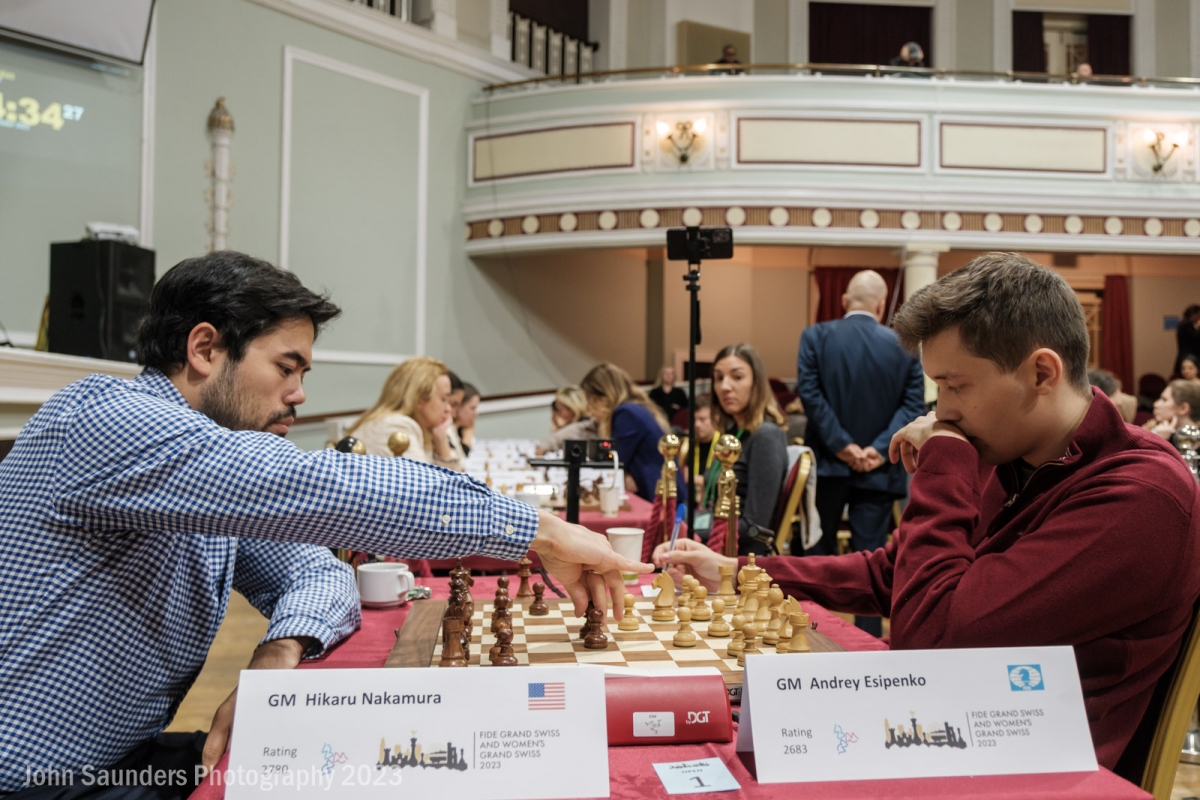
Short, sharp, but drawn: the encounter between joint leaders Hikaru Nakamura and Andrey Esipenko
The game between the leader Andrey Esipenko and Hikaru Nakamura was drawn in 27 moves but was hard fought and interesting despite its brevity. The opening was a Sicilian c3 with maybe a hint of Modern Defence, but its unusual nature meant that the players were having to think for themselves from an early stage. Nakamura played aggressively on the kingside, with Esipenko countering with a pawn sacrifice to exploit Black’s vulnerability on that wing caused by the…g5 thrust. It proved a timely strategy and allowed White to achieve a comfortable draw by perpetual check.
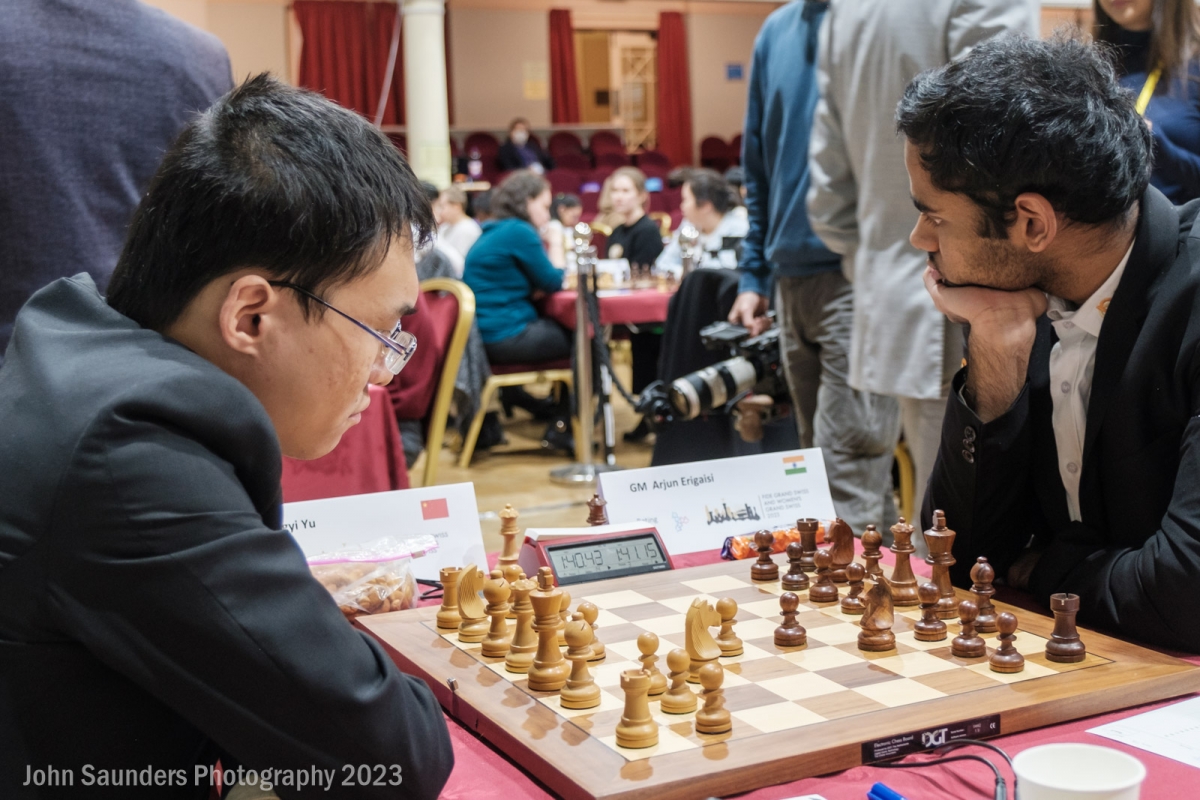
Yu Yangi vs Arjun Erigaisi was a fairly perfunctory draw
Yu Yangyi versus Arjun Erigaisi began with a Petroff Defence and ended with what looked like a perfunctory 30-move draw. Connoisseurs of strange positions might care to look at the position after Black’s move 15, with a huge wedge of 13 pieces in the middle of the board with not a vacant square between them, only to be thinned out by a sequence of 12 consecutive captures to reach a level position with only queens and rooks remaining. Little else of interest occurred.
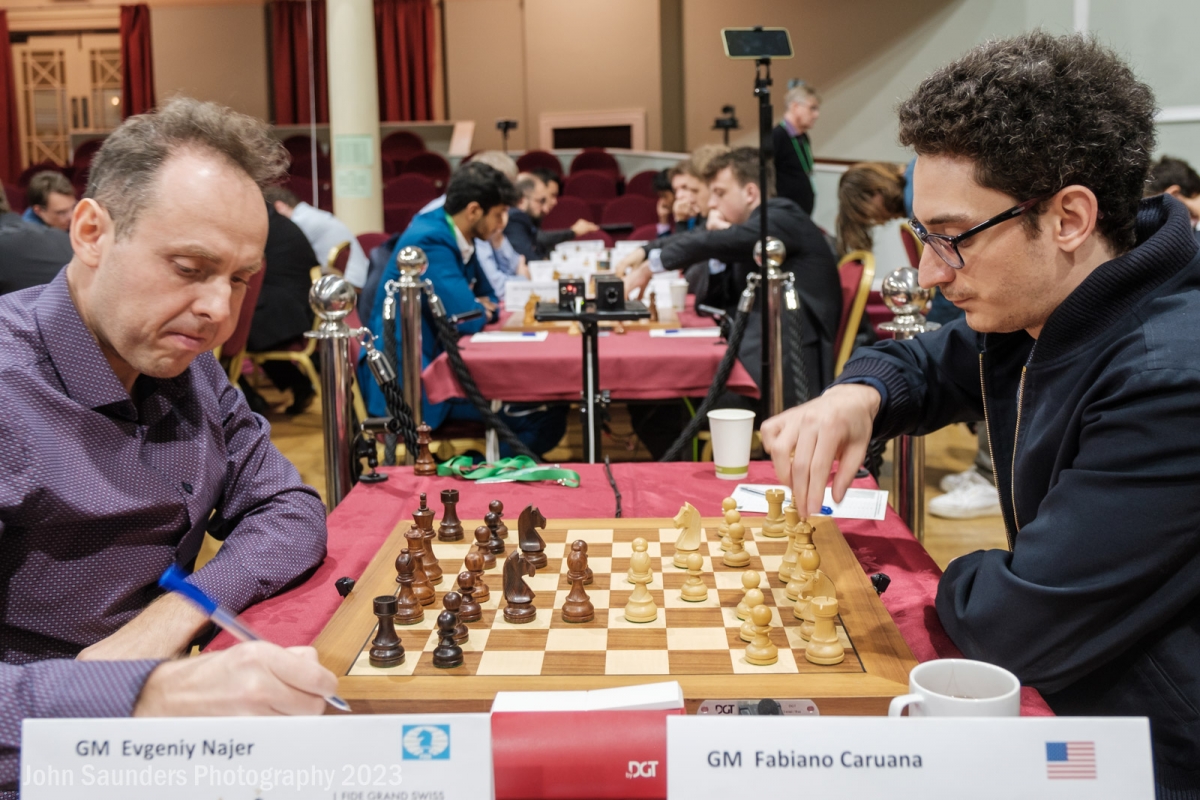
Evgeniy Najer’s position against Fabiano Caruana look OK until he unaccountably gave up two pieces for a rook and a pawn
Top seed Fabiano Caruana rejoined the leaders with a win against Evgeniy Najer. The opening was a Giuoco Pianissimo (Italian). Not a great deal happened until move 25 when Black played the dubious 25…Qa5, followed by a strange blunder, 26…Nf6, which cost him two pieces for a rook and a pawn. Perhaps Black imagined that he might still be able to steer through to a draw, but it proved easy enough for White’s two minor pieces to get coordinated and the residual rook had only limited scope. Caruana closed out the game very comfortably.
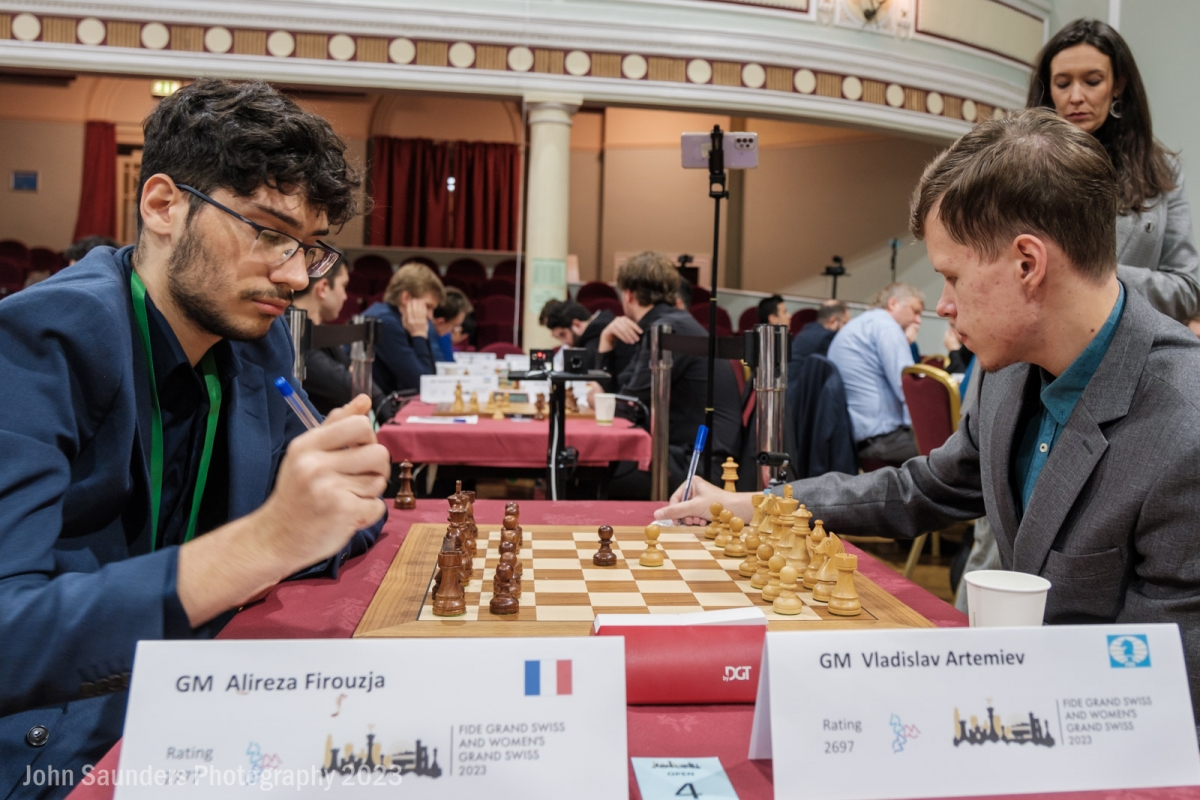
A well-contested game ending in a draw was the story of Vladislav Artemiev versus Alireza Firouzja
Vladislav Artemiev versus Alireza Firouzja featured a Ruy Lopez sideline which saw the queens come off early. White gained a pawn, though doubled and not easily defended. Nevertheless, Artemiev enjoyed an edge as a result. With a minute left for his last five moves, Artemiev surrendered his pawn advantage. Then a tactic allowed him to gain two pieces for a rook but Firouzja must have realised that, with few pawns left, this did not affect his chances of achieving a draw, which duly came about.
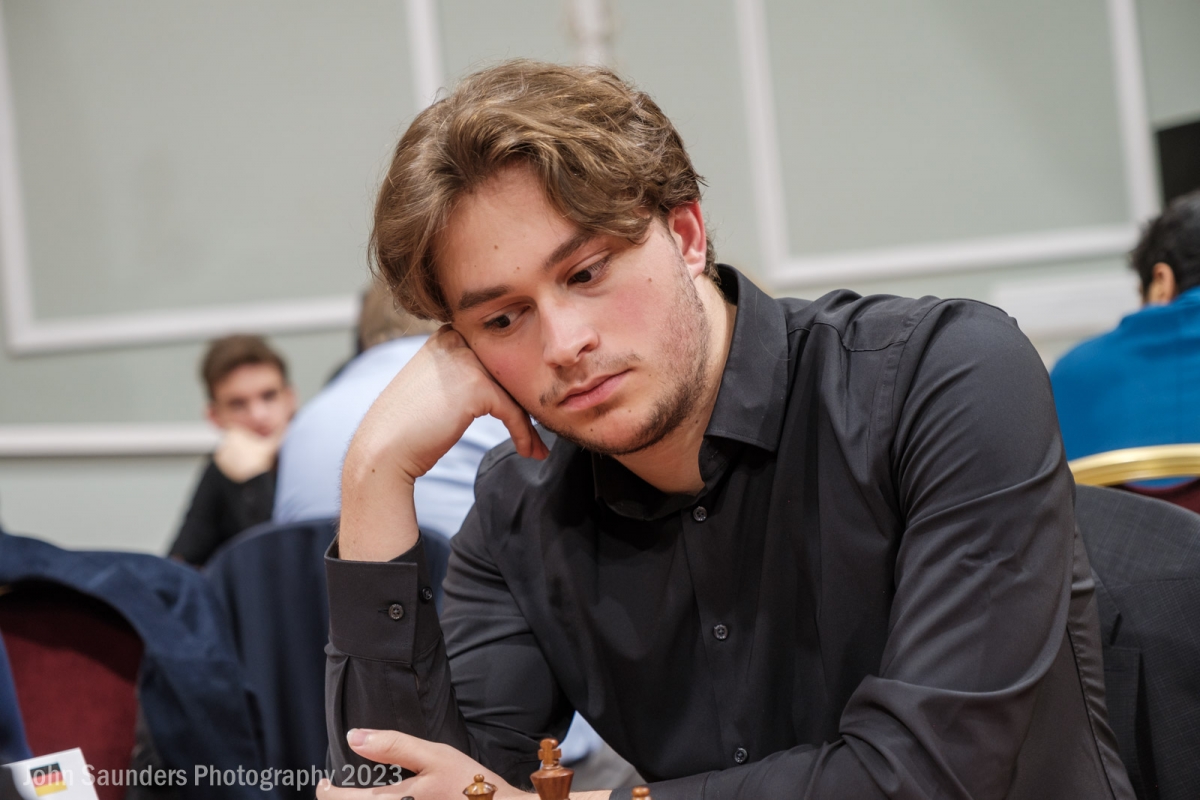
Vincent Keymer secured a material advantage against Nodirbek Yakubboev but couldn’t exploit it to win
Analysis engines would have us believe that Vincent Keymer enjoyed a substantial advantage against Nodirbek Yakubboev, playing the Black side of a Queen’s Indian, but in practice it proved too hard to break down the young Uzbek who recently won the Qatar Masters. Yakkuboev was outplayed in the middlegame and he decided to give up his queen for rook, bishop and pawn rather than lose the exchange. He then gave up a pawn to activate a bishop and complete his defensive wall. Black couldn’t find a way to get his queen, bishop and knight coordinated to find a way through White’s tight defence.
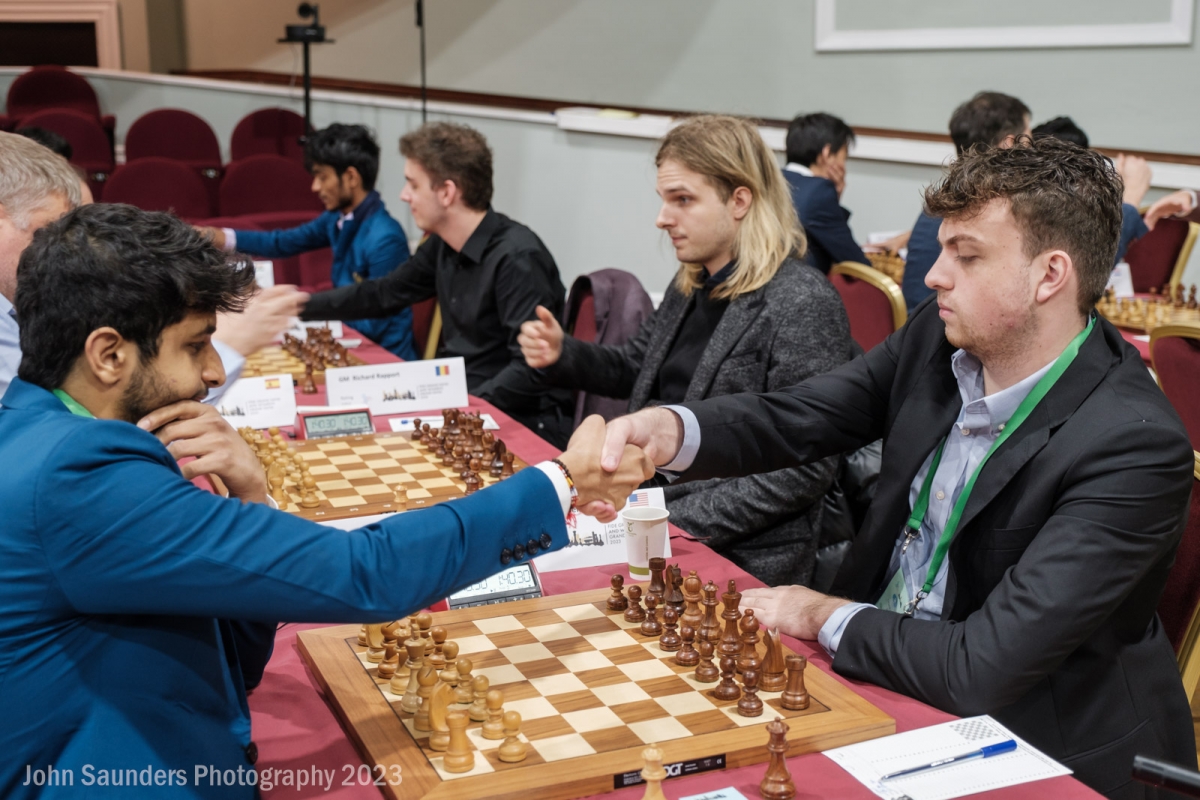
Vidit Gujrathi versus Hans Niemann was a tradionally tough Ruy Lopez game and eventually White triumphed
A previous report mentioned the chess cliché ‘Spanish torture’ which we chess scribblers often use to describe games won by White with the Ruy Lopez, but it was particularly apt in the case of Vidit Gujrathi against Hans Niemann. An Anti-Marshall line led to a position where the Indian GM constantly probed the American’s queenside and Black seemed to have to take it on the chin as his kingside counter failed to get underway. That is, until just before the time control, when Black’s queen finally emerged on h5 with some prospects of at least saving the game. However, an injudicious 39th move spoilt his position, and a pawn was lost. Niemann might yet have saved the game but for missing a chance of a draw on move 48 and seeking a perpetual check which wasn’t there. Having lost his first-round game, Vidit now finds himself in the joint lead.
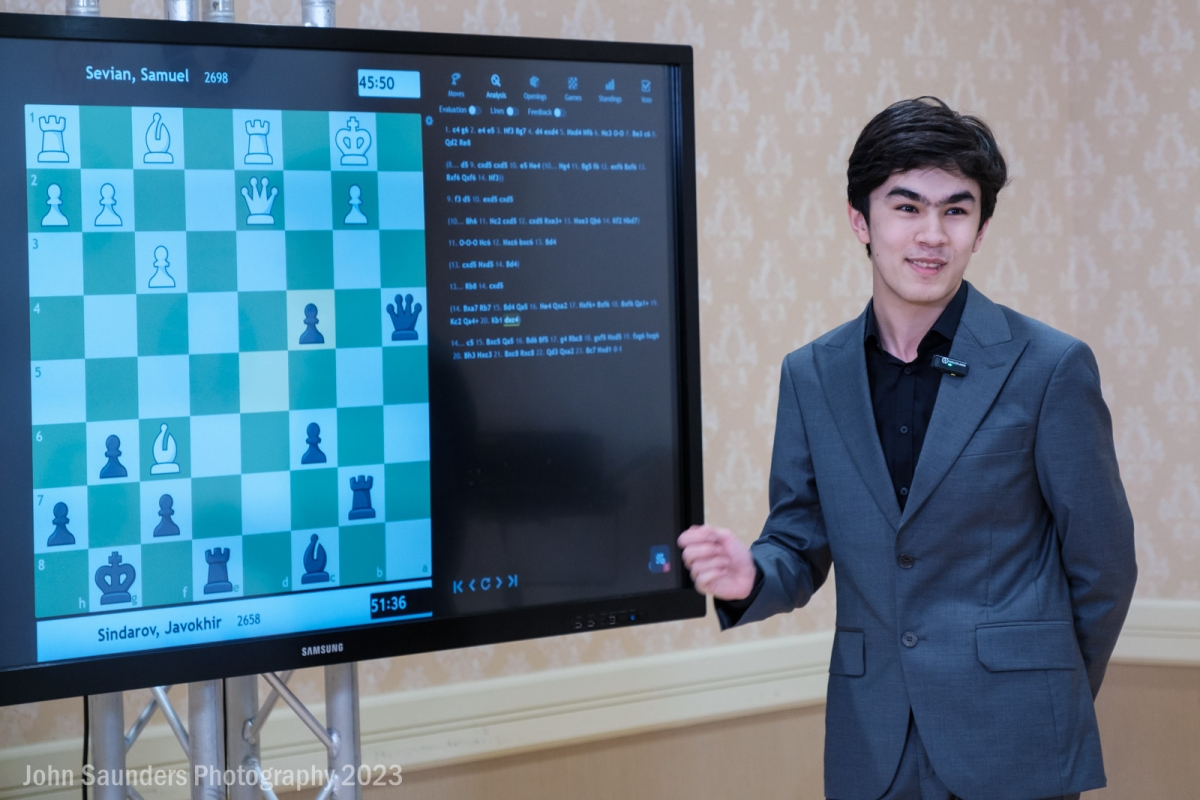
The enthusiastic young GM from Kazakhstan, Javokhir Sindarov, enjoyed demonstrating his win against Samuel Sevian
The game between Samuel Sevian and Javokhir Sindarov was highly entertaining. The US player opened with an English, castled queenside but then played a capture which opened the b-file for rooks to menace his king. It already looked shaky when Sindarov offered pawns for tempi to mobilise his forces against the king. Sevian tried to fend off the counter but soon Black’s whole army pointed at the c3 square with devastating effect. The talented young Kazakh player thus joined the players on the leading score of 4½.
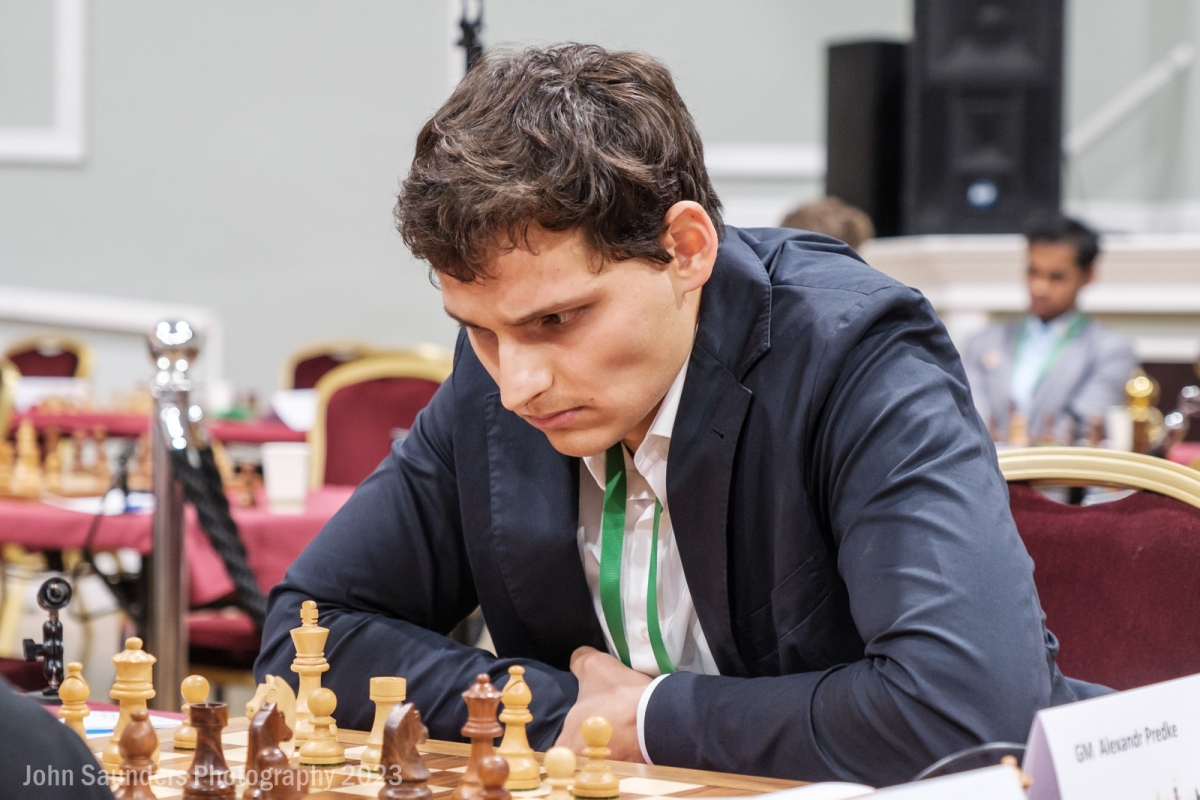
Serbian GM Alexandr Predke played what was perhaps the most original game of the day against Sam Shankland and now ties for the lead
The game between Alexandr Predke and Sam Shankland started life as a Slav Gambit before taking a bizarre turn when White lashed out with 15 Ng6 in a position where engines thought he would have done better to play 15 Nxf7, opening Black up to a big attack. As played, he won the exchange, but his knight was left behind enemy lines on h8. It was one of those positions that you notice in passing in a tournament room and think “how on earth did that get there?” I could go on trying to describe further strange events in this game but it might be better just to show you the score so you can figure it out for yourself. One thing’s for sure is that the Serbian GM played some highly original chess in this game and the way he went on to exploit Black’s undeveloped state – and succeed in restabling his horse from its lonely corner – is well worth looking at.
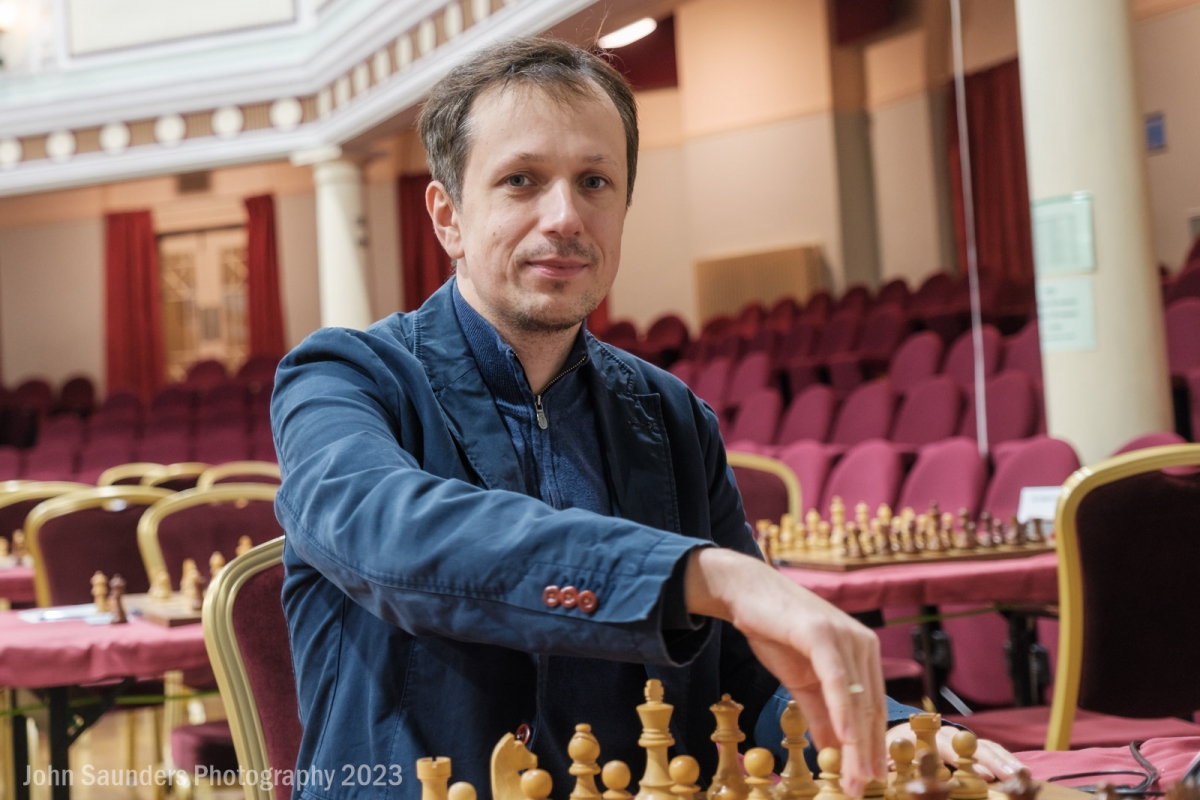
A series of exchanges led to a won rook endgame for Radoslaw Wojtaszek against Erwin L’Ami. He too joins the leaders.
We’ve already acclaimed the tactical wizardry of Radoslaw Wojtaszek on two occasions, and today he achieved the not inconsiderable task of defeating the previously unbeaten Erwin L’Ami. Perhaps the Dutch GM didn’t help himself by punting the Black side of the Albin Counter Gambit. Unless I’m much mistaken (it has been known) Black got very little for his gambit pawn from the opening. On move 19 Black initiated a combination which succeeded in winning back his pawn, swapping off a great deal of material and leaving him with a level rook endgame… but in a clearly lost position. Never was the old cliché “the operation was successful but the patient died” more true. It was one of those rook endgames where the undisputable possession of an open file is decisive in itself. It was also the sort of position which takes a very long time to win but requires to be played out despite there not being a snowball’s chance in hell that a 2400+ player will fail to win it. Which Wojtaszek did: he duly became the eighth player to reach the leading score of 4½/6.
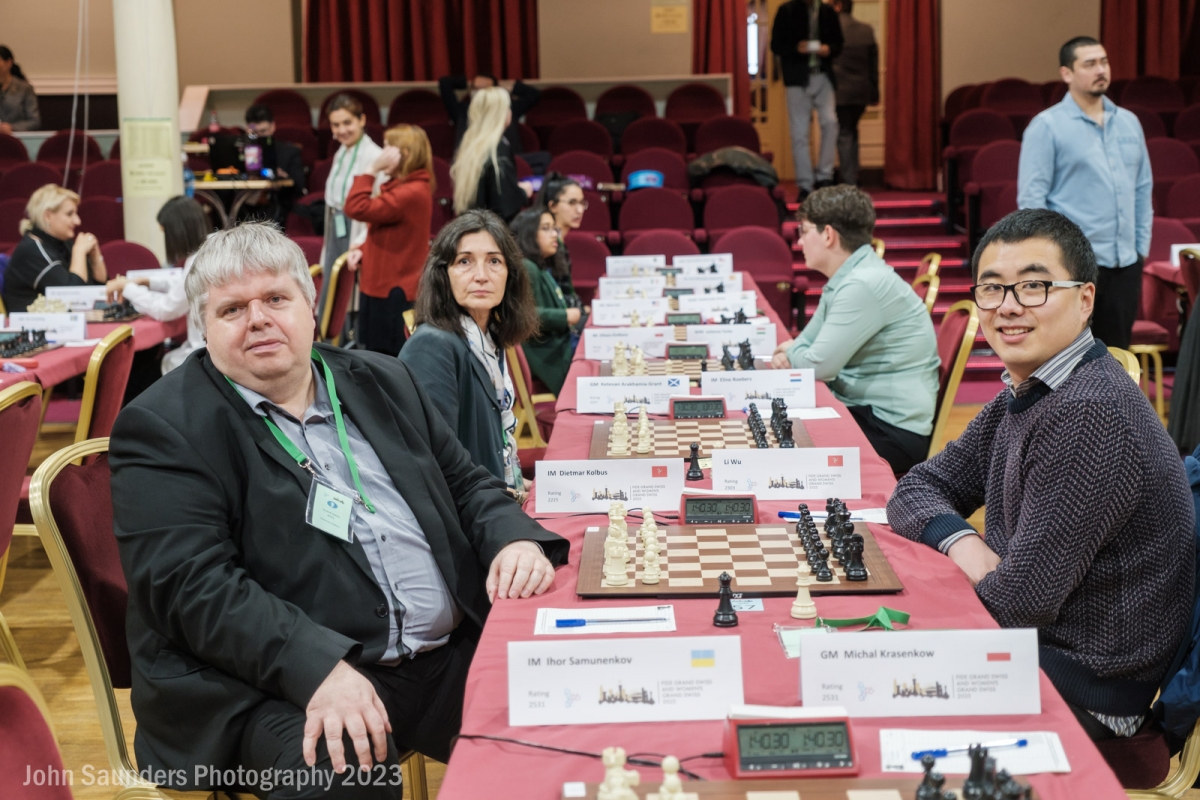
The all-Manx clash between IM Dietmar Kolbus and Li Wu was won by the latter.
As regards the small English contingent: Nikita Vitiugov drew with Hrant Melkumyan so is on 3½, a point behind the leaders, and Shreyas Royal lost to Rauf Mamedov so remains on 2. The two Manx competitors, Dietmar Kolbus and Li Wu, both on ½/5, were paired against each other. Li Wu won with Black to take his score to 1½/6.
—
FIDE Women’s Grand Swiss
There was a change of leadership with Anna Muzychuk defeating Bibisara Assaubayeva and thereby replacing her at the head of the field. Anna Muzychuk has 5/6, with four players on 4½: Aleksandra Goryachkina, Bibisara Assaubayeva, Rameshbabu Vaishali and Antoaneta Stefanova.
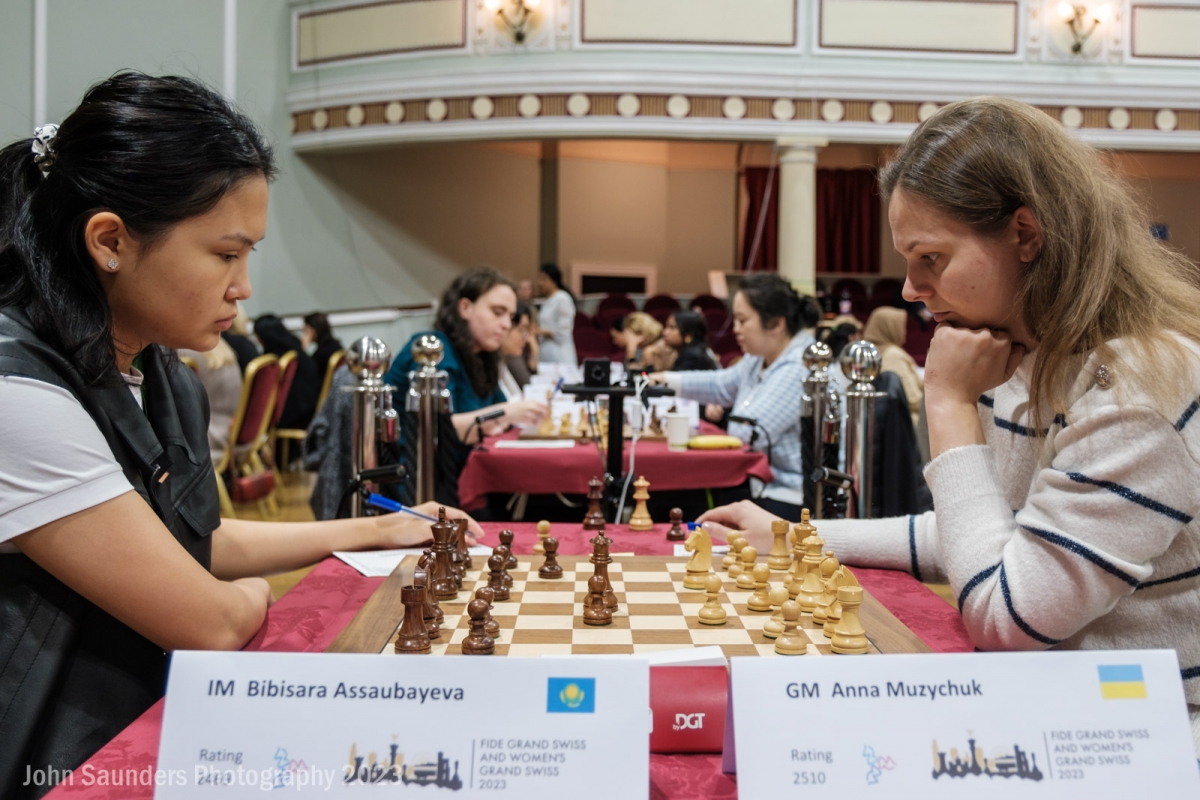
A mistake on move 50 cost Bibisara Assaubayeva the lead and handed it to her opponent, Anna Muzychuk
The top board game between Anna Muzychuk and Bibisara Assaubayeva started with a sedate c3 Sicilian. It remained an even struggle for the first session, coming down to a queen and pawns endgame. However, one of Anna Muzychuk’s pawns was passed and on move 45 she shrewdly opted to advance it rather than play a routine recapture to leave them each with three pawns. This wasn’t enough to win by itself, but it did set her opponent a test. Which, on move 50, Assaubayeva failed when she chose to blockade the passed pawn in a position where it was essential to keep her queen active. Muzychuk grasped her opportunity and within two moves it was obvious that Bibisara Assaubayeva was lost. As always with queen endgames, it took a little longer to conclude but thereafter was never in doubt.
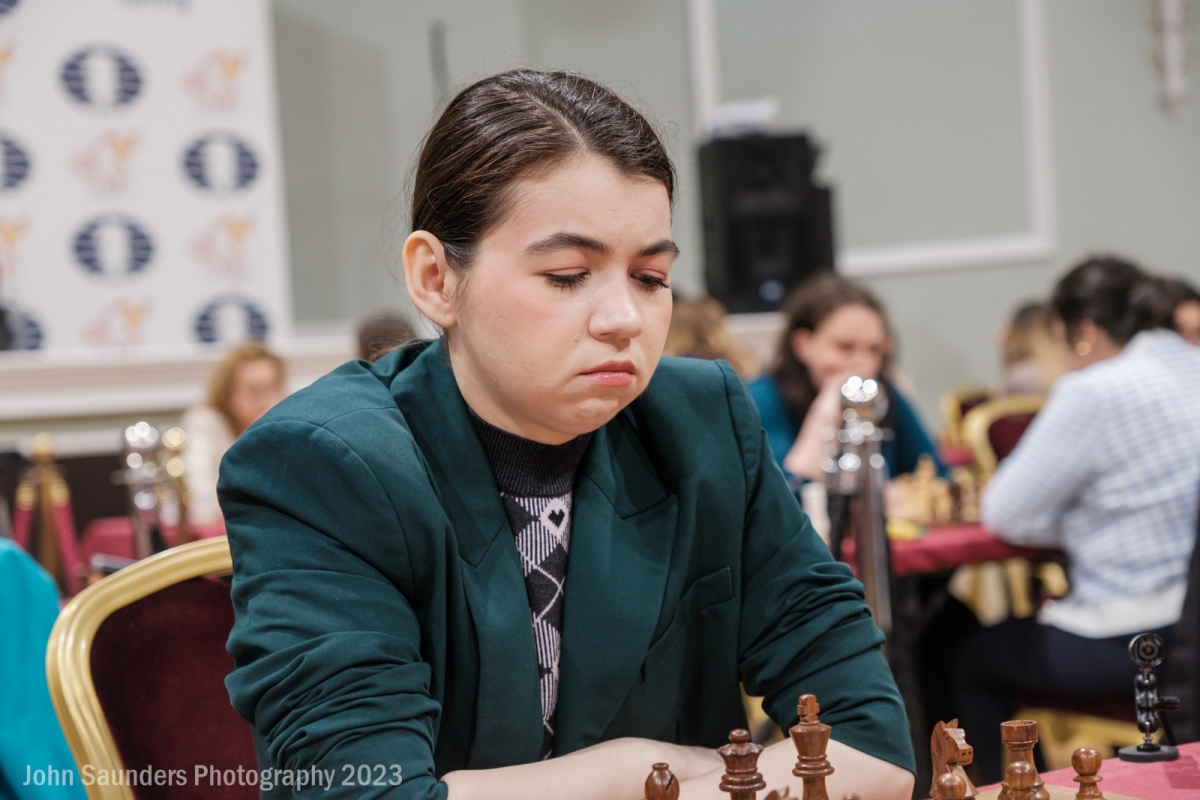
Aleksandra Goryachkina drew her game with rising Indian IM Rameshbabu Vaishali
Rameshbabu Vaishali versus Aleksandra Goryachkina was a Giuoco Pianissimo and lived up to its Italian name. It came down to a level knight endgame with symmetrical pawn blocks and was agreed drawn on move 41.
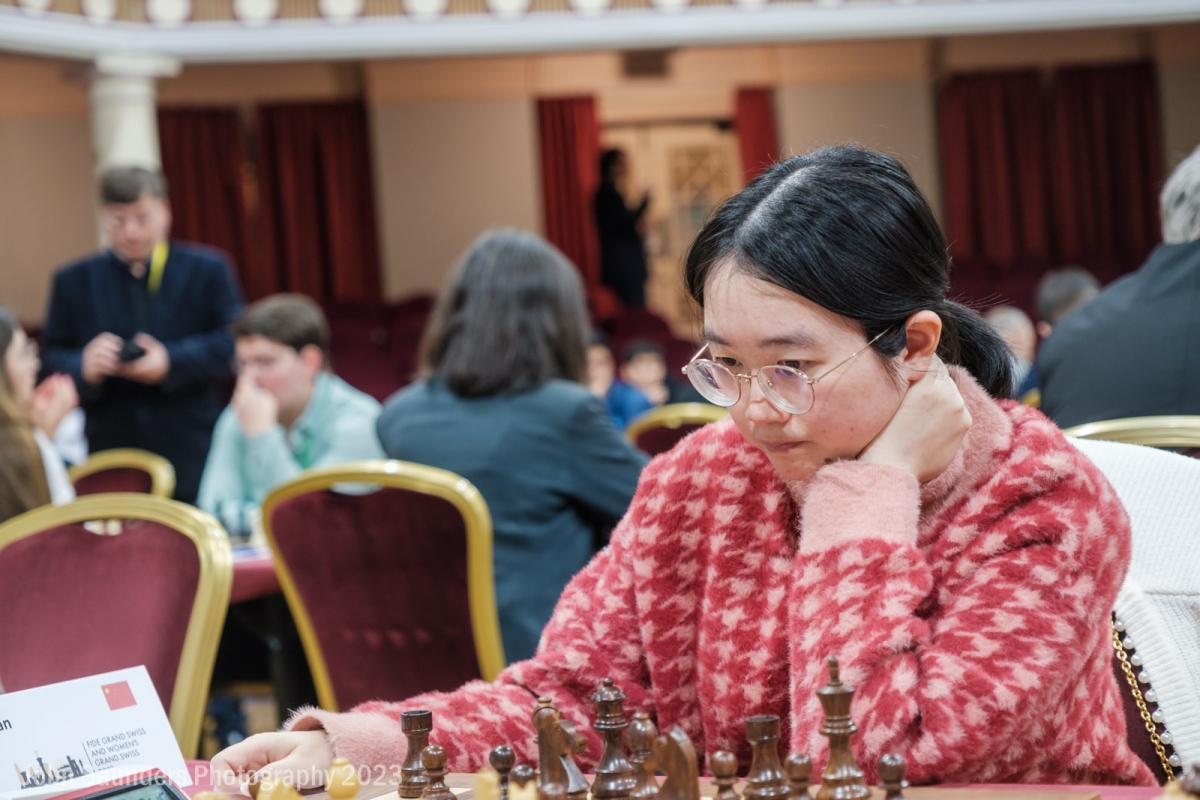
Tan Zhongyi drew with Leya Garifullina and now has 4/6, a point behind the leader
Leya Garifullina versus Tan Zhongyi was well contested but ended in a drawn king and pawn endgame. The game between Marsel Efroimski and Batkhuyag Munguntuul was also hard fought, with the Mongolian player close to winning but eventually thwarted in an endgame where she had bishop and pawn versus (not very advanced) three passed pawns. The Israeli player’s pawns were sufficient distraction to the opponent to help her to the draw.
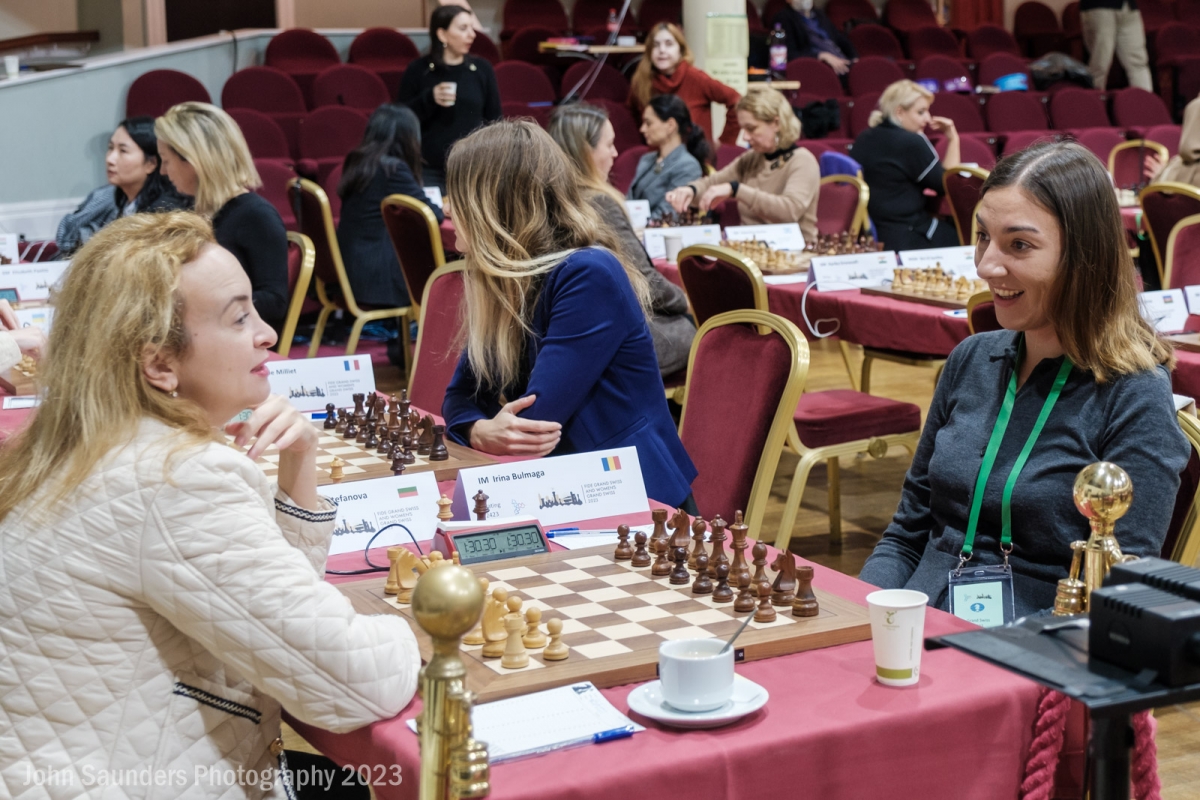
A pleasant chat between Antoaneta Stefanova and Irina Bulmaga before the game… followed by a tough 88-move battle won by White.
The game between Antoaneta Stefanova and Irina Bulmaga came down to an endgame where the Bulgarian ex-world champion had rook, bishop and two pawns versus rook and (opposite-coloured) bishop. Stefanova patiently manoeuvred and improved her pieces until, finally, Bulmaga’s resistance cracked on move 81 and White was able to force one of her pawns to the seventh rank when it was unpoliced by the opposing bishop, making it relatively easy to advance further to the queening square which would be policed by Stefanova’s own cleric. Stefanova thus joins three other players on 4½, half a point behind the leader.
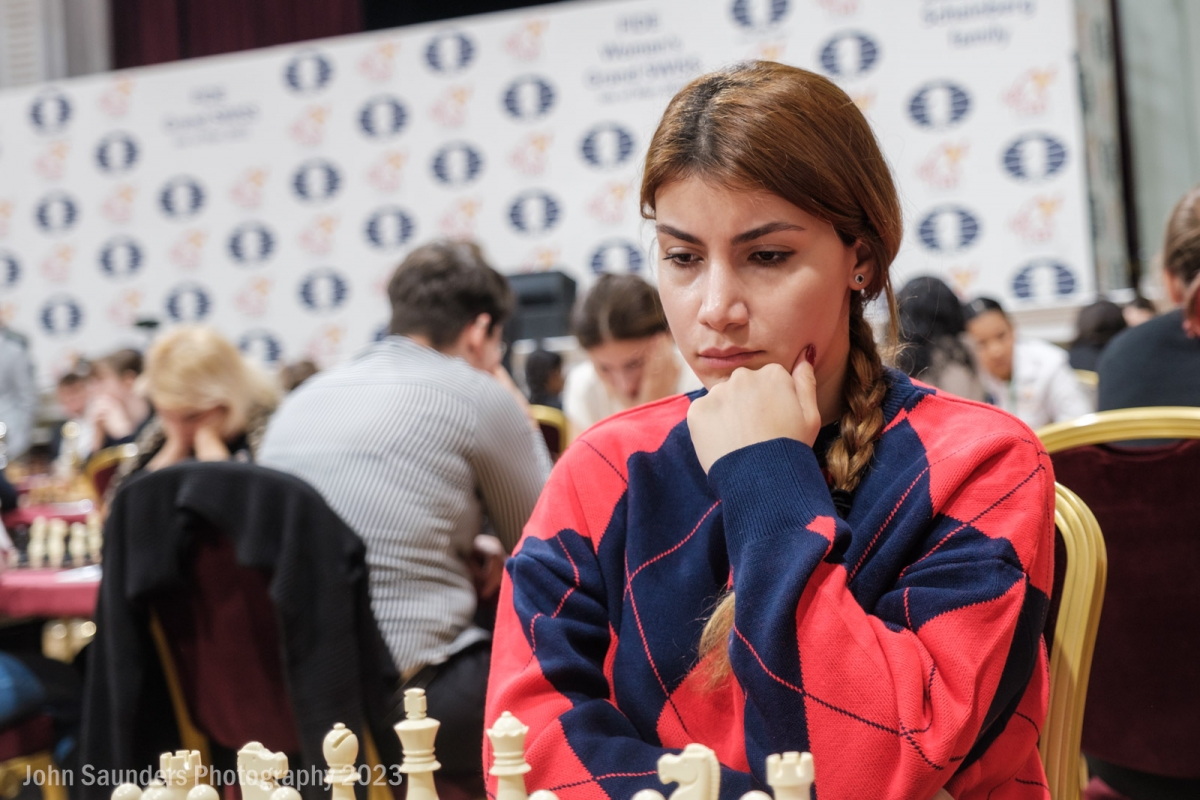
Elisabeth Paehtz thought she was setting a trap for Ulviyya Fataliyeva (pictured) but the Azerbaijani IM had other ideas…
German GM Elisabeth Paehtz tried to trap Ulviyya Fataliyeva by offering a free pawn, only to find that it was she who had been snared.
Addendum: in round four Polina Shuvalova reached the wrong side of a king versus king, bishop and knight endgame against Meruert Kamalidenova and, of course, lost it, in 109 moves. Believe it or not, she reached the same endgame in today’s sixth round, against Govhar Beydullayeva. Shuvalova was Black in both games. It went to 111 moves – but this time Shuvalova was on the winning side.
—
A reminder that there is no chess tomorrow Tuesday and that the tournament will resume with round seven on Wednesday 1 November at 1430 GMT. Join the show with GM David Howell and IM Jovanka Houska on ionchess.com.