John Saunders reports: Until well into the sixth hour it appeared as there would be no decisive games at all on the top twelve boards in round seven of the 2019 FIDE Chess.com Grand Swiss, played at the Comis Hotel, Isle of Man, on 17 October. Then came a fateful moment for Wang Hao: in what had seemed a drawn endgame he faced a tough decision, went wrong and Levon Aronian emerged with a win and a share of first place with Fabiano Caruana. Going into round eight on Friday, Aronian and Caruana have 5½ out of 7, while seven players are on 5 points: Wang Hao (China), Kirill Alekseenko, Alexander Grischuk, Nikita Vitugov (all three Russia), Parham Maghsoodloo (Iran), David Anton Guijarro (Spain) and Magnus Carlsen (Norway). The leading round eight pairings are Caruana-Aronian, Wang Hao-Carlsen, Anton Guijarro-Grischuk and Maghsoodloo-Vitiugov, with Alekseenko receiving a downfloat to Wesley So.
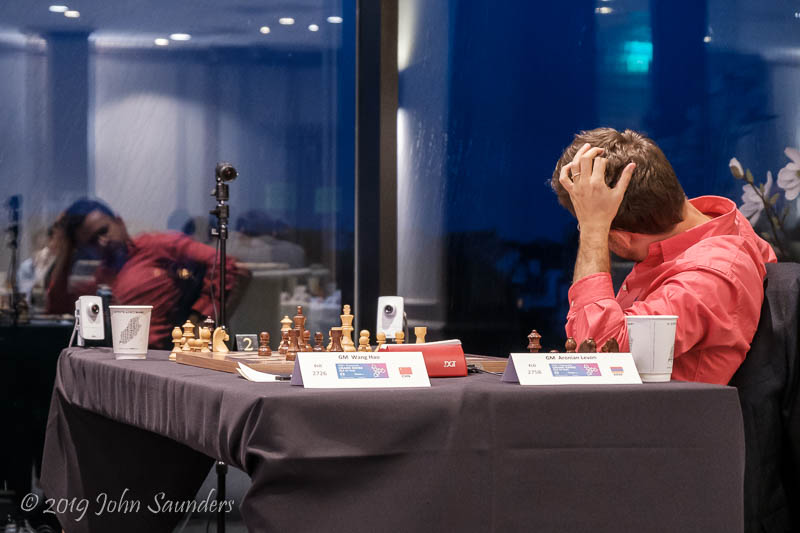
“It’s raining in my heart”: but soon Levon Aronian perked up when Wang Hao failed to find a drawing line (photo: John Saunders)
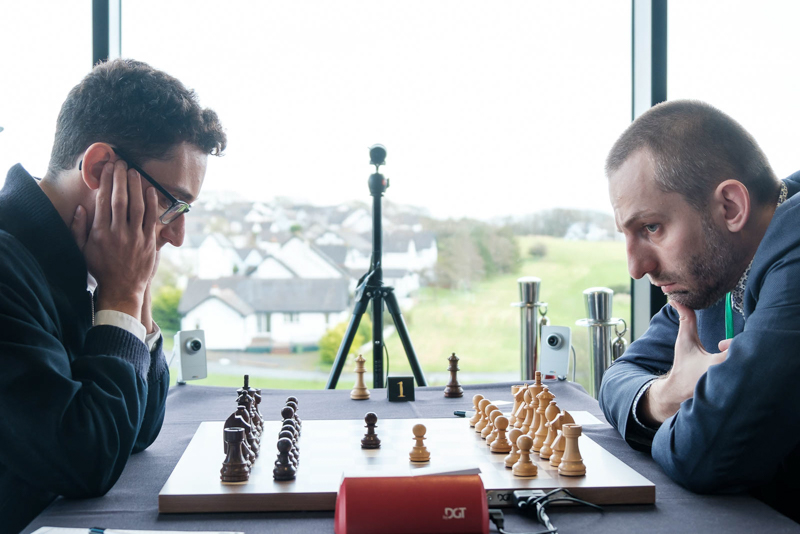
The familiar hunched posture of Alexander Grischuk, thumb in chin, but Fabiano Caruana was not intimidated (photo: John Saunders)
Players, officials and press alike had enjoyed a gloriously sunny rest day on the Wednesday, but the rains came again on Thursday and with them a shower of draws. But they were properly contested draws for the most part, starting with the top board where Alexander Grischuk ’s determined posture and grim visage signalled to Fabiano Caruana that he would be playing long and hard. The game was soon out of the books and a highly imbalanced position resulted, with Grischuk, White, giving up a pawn to obtain a big centre. Both players ran short of time, but the position simplified somewhat in the run-up to the time control and thereafter quickly resolved in a repetition. Commentator Daniel King considered it the game of the day. It featured a lot of difficult positional decisions, probably explaining the time pressure, but on the face of it was accurately played, with no big chances being missed.
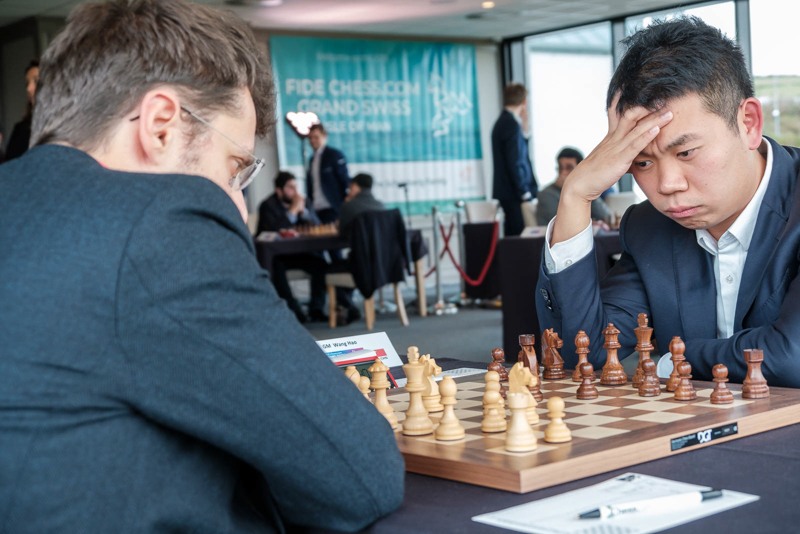
Wang Hao was displaced from the lead when he failed to find the difficult chance 56…Rd3 to hold the game (photo: John Saunders)
Board two was where the only decisive on the leading boards happened. The game began with an orthodox Semi-Tarrasch, with Wang Hao, Black, playing a new move, 12…Bf6. It looked a bit dubious, involving an immediate pawn sacrifice which, though seemingly temporary, became permanent. Swapping down to a heavy piece ending also looked dubious, but the engines remained optimistic about the Chinese super-GM’s chances. However, what the engines didn’t tell us was that he was going to have to find some really tough moves to reach a draw. Levon Aronian kept up the pressure, missing the occasional half-chance to increase his advantage but, finally, with just KRPP v KRP left on the board, Wang Hao missed an obscure only-move to keep the draw in hand. Aronian, to his credit, found the right way to exploit the error and bring home the point. The net effect was for the two players to swap their positions on the leader board going into the eighth round.
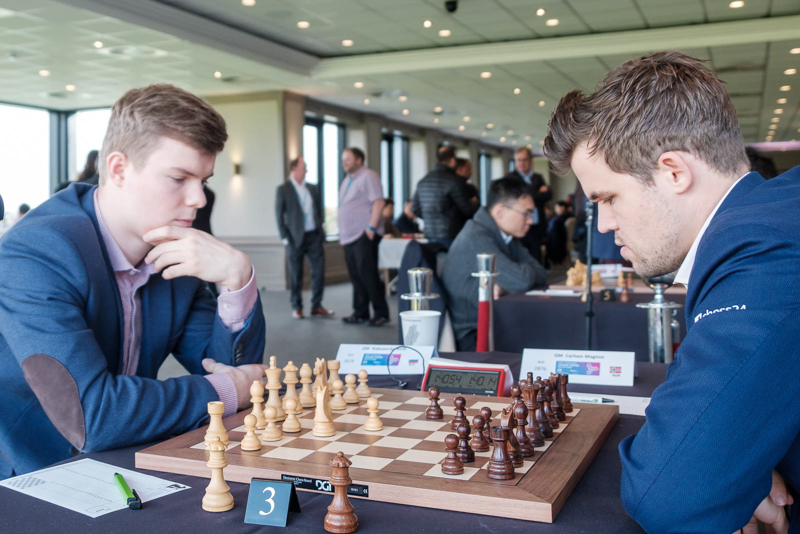
“Nice one, Kirill”: Alekseenko matched Magnus Carlsen move for move: even his suit and appearance were similar (photo: John Saunders)
Magnus Carlsen has yet to win a game with Black in this tournament, so I suppose it was his good fortune that he had had four Whites and two Blacks in the first six rounds. He never really looked like winning against the solid Kirill Alekseenko, who has just broken through to the 2700 level with his fine start to the tournament following his excellent showing in the FIDE World Cup (his combined classical game score in those two events to date being +6, =9, -0, gaining him 30+ rating points). Carlsen tried a Najdorf and Alekseenko opted for a more positional line, exiting theory with 14.Bd2. Carlsen switched his light-squared bishop from b7 round to e6 where it was exchanged. Alekseenko snagged a loose pawn but Carlsen had plenty of activity in compensation. At the time control, still a pawn down, Carlsen disdained a draw by perpetual but it was little more than a token signal to his opponent that he had slightly the better of things. A few moves later Carlsen was a pawn up but in a totally drawn position and, somewhat untypically, he agreed a draw without playing on down to the kings.
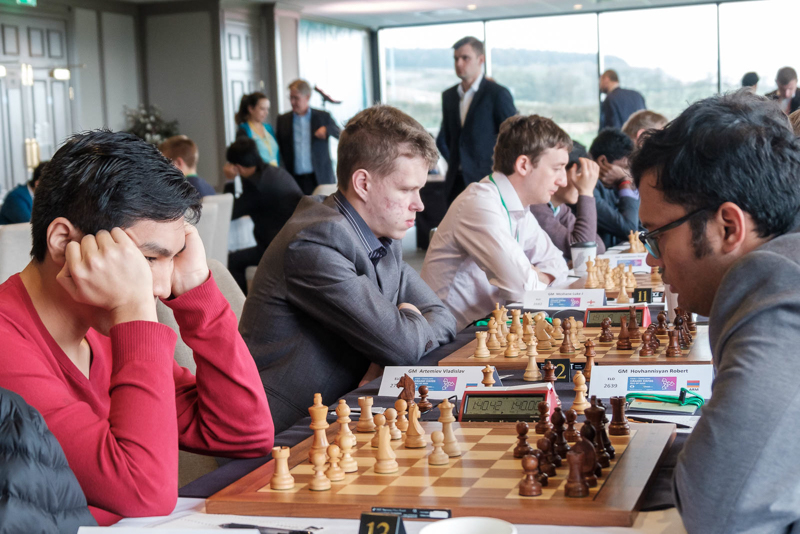
Wesley So started slowly but is running into form with a win against Surya Ganguly (photo: John Saunders)
There wasn’t another decisive result until we get to board 13, where Wesley So defeated Surya Ganguly, though Yu Yangyi looked close to winning against Parham Maghsoodloo at one stage, and Yuriy Kryvoruchko was a clear pawn up against Vishy Anand. In both cases Black fought their way back into the game and defended effectively.
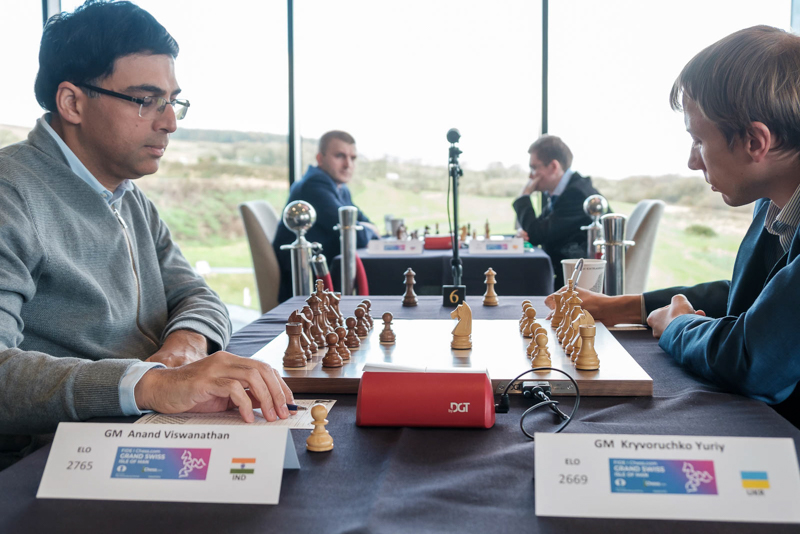
Vishy Anand was a pawn down but held the draw against Yuriy Kryvoruchko (photo: John Saunders)
There were mixed fortunes for Chinese GMs a little further down the lists, with Hrant Melkumyan bamboozling Bu Xiangzhi, who exposed a bit too much of his king to the Armenian, and Zhang Zhong winning a lively Trompowsky against Dr. Bassem Amin (Egypt).
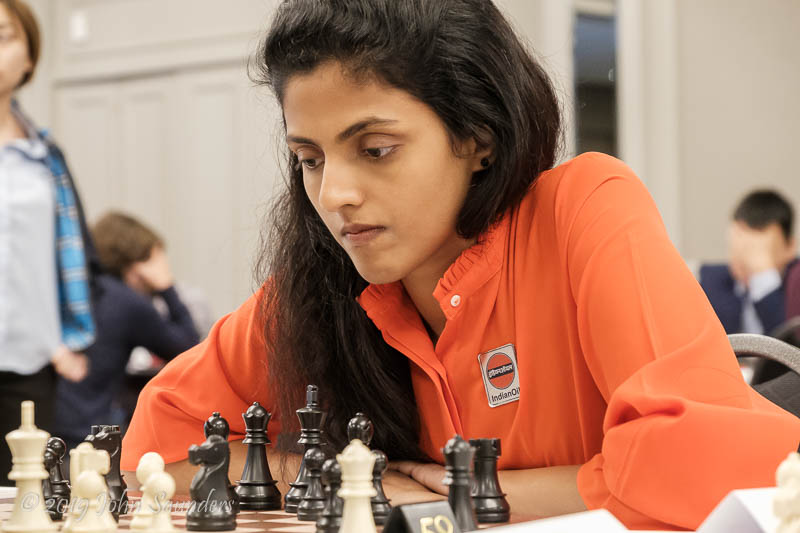
Harika Dronavalli is the top-rated female competitor and now shares the lead with Dinara Saduakaasova in the race for the women’s first prize (photo: John Saunders)
In the competition for the top women’s prize Harika Dronavalli and Dinara Saduakassova (Kazakhstan) are tied on 3½/7 after the Indian GM scored a meritorious win against the 2629-rated Roumanian GM Mircea-Emilian Parligras, while the Kazakh IM drew with the 2644-rated Russian GM Maxsim Chigaev. Five other women players are on 3: Batkhuyag Munguntuul (Mongolia), Lei Tingjie (China), Swaminathan Soumya (India), Elina Danielian (Armenia) and Alina Kashlinskaya (Russia).
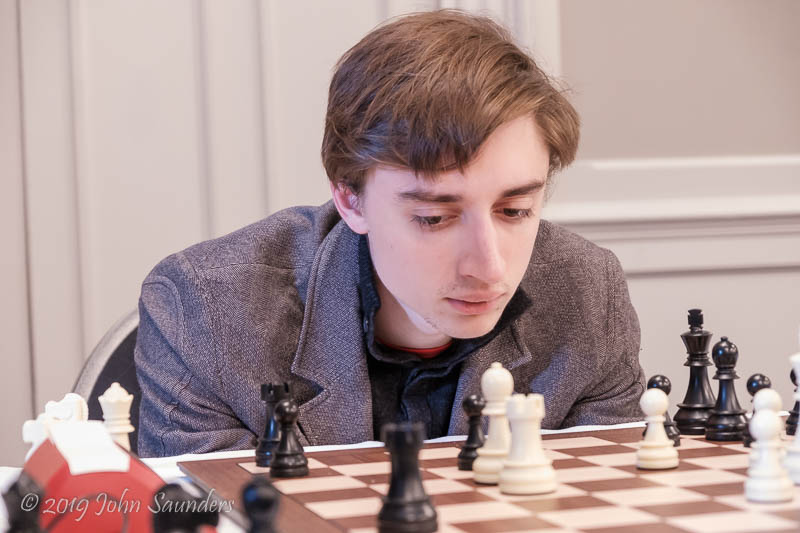
“Oh Danny boy, the points, the points you’re scoring…” Or rather, not scoring. Daniil Dubov is having a nightmare tournament (photo: John Saunders)
Finally – and I hope the player in question will forgive me for drawing attention to this – the current World Rapidplay Champion, Daniil Dubov, also rated a none too shabby 2699 at classical chess, is currently languishing on a score of 2½/7 with not a single win to his name as yet. If that isn’t a measure of how monstrously strong this tournament is, I don’t know what is.